![Sterling Edge Logo.png]](https://info.sterlingedgefinancial.com/hs-fs/hubfs/Sterling%20Edge%20Logo.png?height=50&name=Sterling%20Edge%20Logo.png)
You have a budget. You manage cash flow. High-interest debt is mostly behind you. You own a home, have a car payment, and are wrapping up student loans. Income has increased—so why can it still feel impossible to get ahead?
For many emerging professionals, the answer is not poor spending habits. It is that a traditional emergency fund does not capture the full picture. The usual guideline—three to six months of essential expenses—is a valuable starting point for unexpected events or income disruption. But a stronger cash strategy also accounts for future expenses that may be predictable, even if their exact timing is not.
The “Fog of War” in Cash FlowA furnace may fail. A roof claim may leave you responsible for a large deductible. Tires, vehicle service, medical bills, and education costs can appear with little warning.
Then there are costs that are not emergencies at all:
- A $4,000 destination wedding next year.
- A $15,000 family vacation in two years.
- 50,000 mile car maintenance, $2,000.
- New windows in the next 5 years for $45,000.
- Estimated quarterly tax payments of $25,000.
None of these expenses should be shocking. Yet they can still become financially disruptive if there is no money set aside for them. That is the fog of war: obligations exist in the background, but a 12-month budget may not make them visible.
A Better QuestionInstead of asking only, “Do I have six months of expenses saved?” ask:
“How much accessible cash do I need to stay in control when life and my existing commitments arrive?”
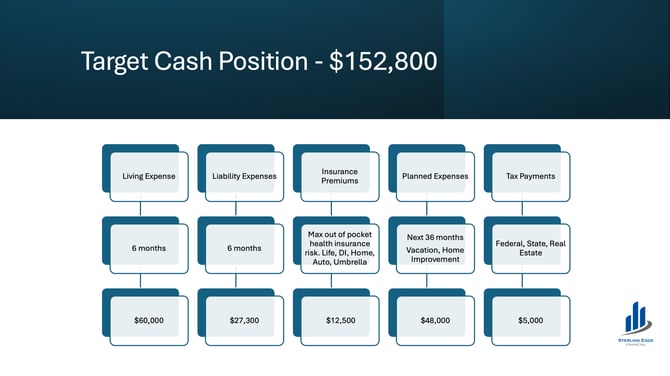
That number is your Target Cash Position.
An emergency fund is generally reserved for unexpected, necessary costs or loss of income. A Target Cash Position includes that reserve, but adds planned spending, known future liabilities, insurance deductibles, and other near- to medium-term obligations.
In other words: the emergency fund protects you from surprises. A Target Cash Position helps prepare you for both surprises and foreseeable costs.
A Real-Life ExampleWhen my wife and I bought our home in 2022, the inspection was helpful, but it did not eliminate future obligations. It helped identify them.
We could see several likely costs ahead:
- The HVAC system had roughly eight years of useful life remaining; replacement was estimated at $20,000 or more.
- The original windows appeared to be nearing the end of their useful life; replacement was estimated around $40,000.
- HOA notes indicated a garage-door replacement would be required by 2027, estimated at $5,000 to $8,000.
- Our vehicle would likely require major service or replacement by 2026.
Those expenses were not all due immediately. But they were real. Ignoring them would not make them disappear; it would only make borrowing, delaying, or selling investments more likely when the bills arrived. (Below is an example)
How to Build Your Target
Start with five buckets:
| Cash need | What to include |
|---|---|
| Living expenses | Core household spending for a chosen reserve period |
| Debt obligations | Mortgage, car loans, student loans, and other required payments |
| Insurance exposure | Health, disability, life, auto, home, umbrella premiums and key deductibles |
| Planned expenses | Travel, education, vehicle purchases, home repairs, and other known goals |
| Tax obligations | Estimated quarterly tax payments or other expected tax liabilities |
The goal is not to hold every future dollar in cash today. That would be impractical and could slow long-term investing. Instead, identify the expense, estimate its cost and timing, and create a savings schedule. A $15,000 vacation two years away is not a $15,000 emergency, it is a roughly $625-per-month planning decision.
Keep More ChoicesA Target Cash Position is not about hoarding cash. It is about reducing forced decisions.
When a major expense arrives, sufficient cash can help you avoid taking on high-interest debt, draining an investment account at the wrong time, or treating a predictable obligation like a crisis.
Your target should evolve as your income, home, family, insurance coverage, taxes, and goals change. Think of it as a living number, not a one-time savings target carved into stone.
Ready to see whether your current emergency fund matches the life you are building? Let’s identify the future obligations already on your balance sheet and design a Target Cash Position that helps you stay in the driver’s seat.
References:
CFP Board: Guide to the Financial Planning Process
CFP Board: Emergency Fund
Consumer Financial Protection Bureau: Emergency Savings