![Sterling Edge Logo.png]](https://info.sterlingedgefinancial.com/hs-fs/hubfs/Sterling%20Edge%20Logo.png?height=50&name=Sterling%20Edge%20Logo.png)
Iran's Supreme Leader has been confirmed dead, and Iran has responded with missile and drone attacks throughout the Middle East. President Trump has stated that the goal of the operation, called "Operation Epic Fury," is to change the Iranian government, with strikes expected to continue for several weeks. A number of U.S. troop casualties have already been reported.
The situation is changing quickly, and the well-being of civilians in the region and U.S. troops is the top priority. While the seriousness of these events cannot be overstated, investors will understandably have questions about what this means for financial markets, oil prices, and their own portfolios.
President Dwight D. Eisenhower once said that "plans are worthless, but planning is everything." Applied to today, this means that while specific events like this one are hard to predict, the fact that crises happen regularly is not surprising. Building a diversified portfolio — one that spreads investments across different types of assets — and making thoughtful financial plans is designed precisely to handle this kind of uncertainty. Financial markets have worked through countless wars, crises, and regional conflicts throughout history, including the U.S. operation in Venezuela earlier this year.
The key for long-term investors is to avoid letting geopolitical news drive investment decisions. So, what should investors keep in mind as events unfold over the coming weeks?
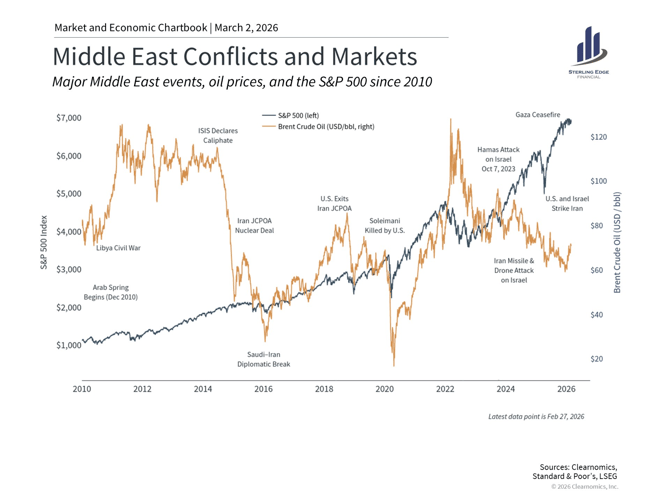
These strikes are the latest development in a long-running conflict
Although the current strikes are significant in scale, tensions between the U.S., Israel, and Iran have been building for a long time. This latest development comes after a monthlong U.S. military buildup in the region, failed negotiations over Iran's nuclear program, and President Trump's pledge to support Iranian protesters who challenged the regime earlier this year.
To understand how we got here, it helps to look at the broader sequence of events:
- Tensions between Iran and Western nations go back decades. Iran has long supported groups like Hezbollah and Hamas, which have been involved in conflicts across the Middle East.
- In 2019, Iran launched drone strikes against Saudi Arabia's oil infrastructure, briefly disrupting global oil supplies and raising fears of a wider war.
- Hamas's October 2023 attack on Israel reignited conflict in the region, eventually drawing in Hezbollah and increasing tensions with Iran.
- Last summer, Israel conducted a 12-day military campaign against Iran, targeting nuclear and missile programs — the most direct confrontation between the two countries in decades.
- Earlier this year, Iranian protesters challenged the regime, with President Trump pledging U.S. support.
- Negotiations over Iran's nuclear programfailed to reach an agreement. In recent weeks, a major U.S. military buildup in the region signaled that a larger operation was being planned, leading to the current strikes.
The current strikes — including targeting Iran's top leadership — are broader than previous actions. However, history shows that even serious geopolitical conflicts are not always the main driver of market movements.
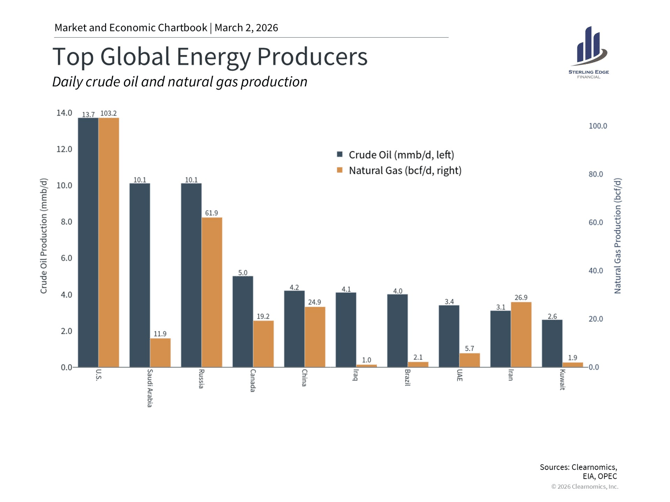
For investors, the most direct connection between Middle East conflicts and financial markets is through global energy prices.
Iran is a member of OPEC — a group of major oil-producing countries — and produces around 3 million barrels of oil per day and 27 billion cubic feet of natural gas per day. Iran also borders the Strait of Hormuz, the world's most important energy shipping route.
According to the U.S. Energy Information Administration, roughly one-third of all oil shipped by sea and one-fifth of all natural gas passes through this waterway. Even the possibility of disruption there could affect global energy markets.
Oil prices had already been climbing in anticipation of the strikes. Following the strikes, prices jumped further, with WTI crude oil reaching the low $70s per barrel and Brent crude rising to just under $80 per barrel. Even though Western countries do not directly import oil from Iran, oil is a global commodity, meaning any reduction in supply anywhere can push prices higher everywhere.
Some perspective is helpful here.
Current oil prices are still well below the 2022 peak of nearly $128 per barrel, which occurred when Russia invaded Ukraine. Today's situation is also different in an important way: in 2018, the U.S. became the world's largest producer of oil and natural gas, with domestic output exceeding that of Saudi Arabia and Russia. This high level of domestic production helps protect the U.S. economy from the full impact of global supply disruptions.
It is also worth noting that oil prices are notoriously difficult to forecast. When Russia invaded Ukraine, many expected prices to stay elevated for a long time. Instead, prices stabilized and fell much sooner than most predicted. Similarly, the U.S. operation in Venezuela earlier this year caused a brief rise in oil prices but had little lasting effect.
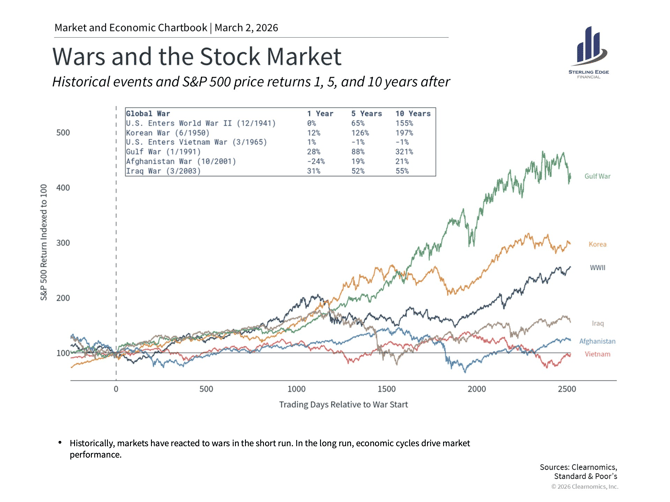
Why staying invested during uncertain times matters
It is completely natural to feel anxious when news headlines are filled with military strikes, retaliatory attacks, and the risk of a wider war. These events have real human consequences and feel very different from routine market news about corporate earnings or economic data.
The accompanying chart shows clearly that markets have managed to recover from even the most serious global events. From World War II to the Gulf War to the wars in Iraq and Afghanistan, markets went through short-term ups and downs but were ultimately guided by the strength of the underlying economy over the long term. More recently, the conflicts between Russia and Ukraine, and between Israel and Hamas, created uncertainty but did not permanently derail the broader direction of markets.
It is also worth noting that Iran has very little direct presence in most investment portfolios. Iran has faced heavy economic sanctions — restrictions placed by other countries to limit trade — for many years. Its economy has suffered from hyperinflation, which means prices have risen extremely rapidly, and its currency, the Rial, has lost most of its value. As a result, very few investors have any direct exposure to Iran in their portfolios.
Markets may be volatile — meaning prices could swing up and down — in the coming days and weeks as the situation develops. Oil prices could rise further, and uncertainty may shake investor confidence. However, trying to time these movements by moving in and out of investments has historically done more harm than good. Markets have shown the ability to rebound quickly and unexpectedly, and missing even a small number of the best trading days can meaningfully reduce long-term investment returns.
.png?width=670&height=377&name=Blog%20End%20Caps%20(6).png)
Registered Representative, Securities offered through Cambridge Investment Research, Inc., a Broker/Dealer, Member FINRA/SIPC. Investment Advisor Representative, Cambridge Investment Research Advisors, Inc., a Registered Investment Advisor. Cambridge and Sterling Edge Financial are not affiliated.
The information in this email is confidential and is intended solely for the addressee. If you are not the intended addressee and have received this in email in error, please reply to the sender to inform them of this fact. Sterling Edge Financial does not provide tax advice or prepare tax returns.
Clearnomics Definitions, Disclaimers & Methodology
8799696.1